
Perennial asters are flowers no autumn garden should be without. They are dependable and bring valuable colour as the year starts to wind down. They can also cope better than expected in heat and drought, although they will look even better with a good soak once or twice.
There are many varieties for mixed borders and perennial borders. Some are knee-high, others reach head height. You can find neat, compact sorts for containers or the very front of the border, as well as taller plants that will rise through planting or appear behind old roses. Many are excellent cut flowers. Dwarf types, often sold in flower at garden centres, also make useful emergency fillers later in the season.
Top eight autumn aster choices
• ‘Blue Star’ (heath aster): Prolific clouds of small lavender-blue daisies fade almost to white, with eyes that turn from purple to yellow. Mildew resistant. 60cm.
• **‘Coombe Fishacre’ (**Aster hybrid): Repeatedly branching flowerheads give a long season of purplish-pink flowers, with primrose eyes that soon turn purple. Mostly mildew resistant. 90cm.
• ‘Golden Spray’ (heath aster): Dense heads packed with small flowers, white petals and a rich golden eye. Mildew resistant. 90cm.
• ‘Fellowship’ (New York aster): Elegantly open sprays of double, pale pink flowers late in autumn. Not mildew resistant. 1m.
• ‘Forncett Flourish’ (Italian aster): Prolific, purple-tinted, rich blue flowers with golden eyes on self-supporting plants. Mildew resistant. 45cm.
• ‘Helen Picton’ (New England aster): Mildew-resistant plants topped with unusually rich violet-purple flowers. 1.2m.
• **‘Little Carlow’ (**Aster hybrid): Upright, often self-supporting growth with bright yellow-eyed, lavender-blue flowers. Mostly mildew resistant. 1.2m.
• ‘Rosa Sieger’ (New England aster): Very striking, with unusually large flowers in especially vivid rose pink. Mildew resistant. 1.2m.
Autumn asters in the garden
Asters are versatile plants, but it still pays to choose the right one for the right place.
Containers: ‘Professor Anton Kippenberg’ is robust, reliably short and has full-sized lavender-blue flowers. It is often available in garden centres as well as by mail order. 30cm.
Mixed borders: ‘Prince’ has attractively bronzed spring foliage, topped with red-eyed pale daisies. 50cm.
Instant fillers: For an easy filler that starts flowering earlier than most and keeps going well into autumn, choose the large-flowered ‘Rudolf Goethe’.
Perennial borders: ‘Ringdove’ forms strong, tight clumps topped with clouds of pale lavender flowers with primrose disks. 1m.
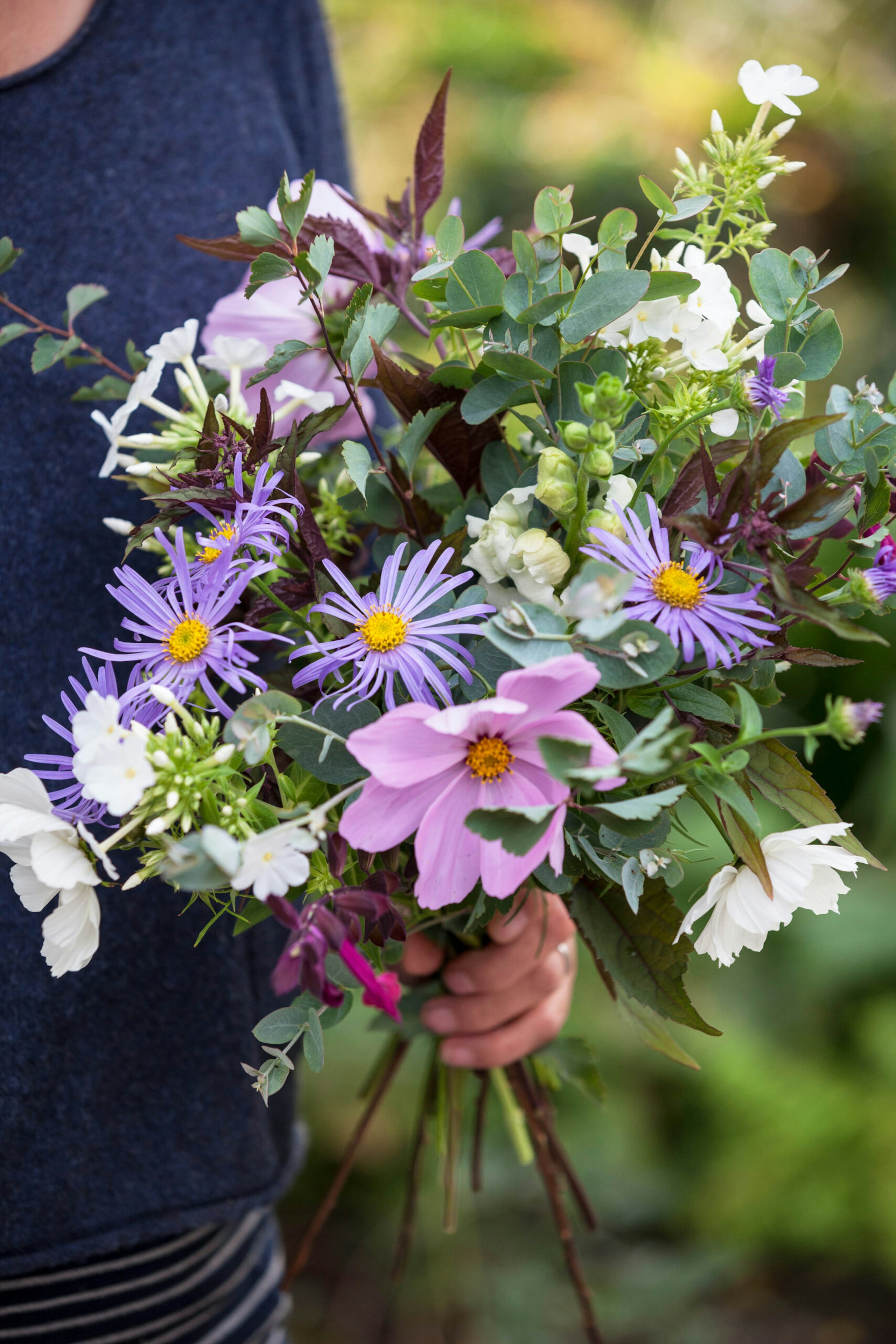
Choosing autumn asters for cutting
Autumn asters make excellent perennials for cutting and can be used in several ways:
• Plant four or five varieties together in different colours for picking
• Pair their airy sprays with larger blooms, such as roses or dahlias, for a balanced mix of big and small flowers
• Use them in informal, cottage-style arrangements
• Cut stems when about a third of the flowers in a spray are open. Strip off the lower leaves, at least all those that would sit under water in the vase, and use flower food.
Top varieties for cutting include:
• ‘Monch’: Larger than average lavender-blue flowers with bright yellow eyes. 90cm.
• ‘Monte Cassino’: Clouds of bright white daisies that suit almost any arrangement. 1.2m.
• ‘Ochtendgloren’: Branched heads of pink flowers over an unusually long season. 1.2m.
The mildew problem
Powdery mildew can be a major issue on autumn-flowering perennial asters. It shows as a white, dusty coating on the leaves. Foliage then turns brown and crisp and drops off.
In general, infection is limited to one group: Symphyotrichum novi-belgii (New York asters). However, this group has more varieties than any other, so avoiding it can greatly reduce your choices.
There are still plenty of options from other groups, including Aster amellus (Italian aster), A. frikartii (hybrid), Symphyotrichum ericoides (heath aster) and S. novae-angliae (New England aster), offering a wide range of styles. In some seasons, especially when plants are challenged by hot, dry weather, resistance can partially break down.
Growing tips
Situation: All these plants grow poorly in shade. They do not always need full sun, but most do well in open positions that are not shaded from above.
Planting: These asters are best planted in spring.
Drought: In dry spells, plants often lose their lower leaves. In the recent drought, many lost foliage and ended up with branched flowerheads on bare stems. An occasional soaking makes a big difference.
The Chelsea chop: Taller asters are ideal for the Chelsea chop. In mid to late May, around the time of the Chelsea Flower Show, cut taller varieties back by half. This encourages shorter, bushier growth that should not need support. Flowering will be delayed, but that is often helpful.
Deadheading: Deadhead promptly after flowering to stop plants looking untidy, reduce self-sown seedlings and avoid weakening the plant.
What's in a name?
In recent years, botanists decided the plants long known as asters are too varied to sit under one botanical name. A few remain as Aster, but many, including most covered here, have moved to Symphyotrichum. Others are now called Eurybia or Seriocarpus.
Nurseries are understandably cautious, but if you ask for an aster, you should still get the right plant, whatever name it is sold under.
Love what you’re reading? Subscribe to Garden News and get the latest gardening advice, plant care tips, and outdoor living ideas delivered straight to your door. Whether you're a seasoned grower or just starting out, Garden News brings you expert insights that’ll help your garden thrive.